



- For order and inquiry :
- Send to us :
Dry Electrical Transformers


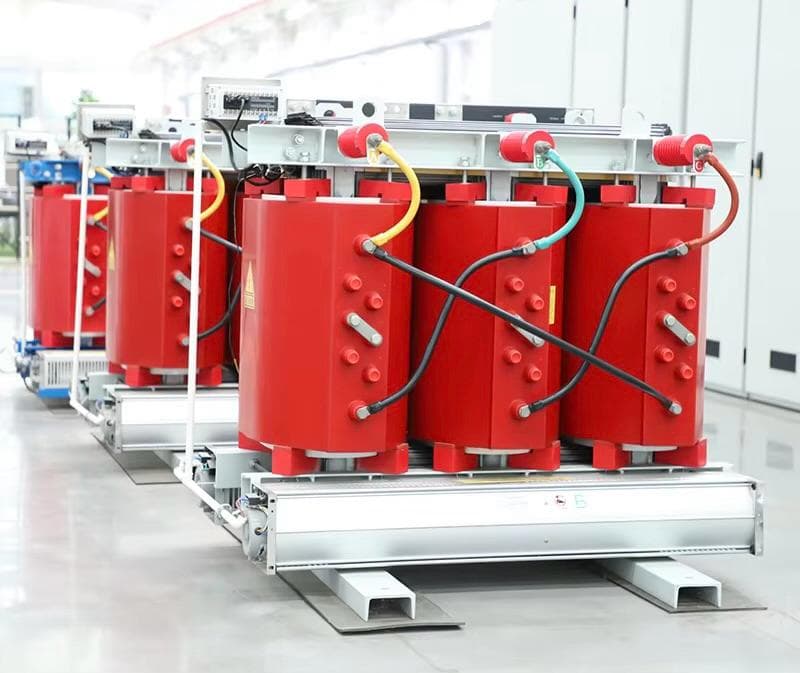
- Dry Electrical Transformers
-We provide you with high-quality dry-type transformers from trusted local and European brands, in various sizes to meet all your operational needs with efficiency and reliability.
Sizes range from 25 kVA to 2500 kVA
What is a dry-type transformer?
It is a type of transformer in which the coils and iron core are not immersed in oil, but are placed directly in the air. This type is preferred for use in residential buildings and indoor spaces because it is safer than oil-type transformers. Dry-type transformers are easy to maintain, but all dry-type transformer applications are low-power, and their price is approximately 30% higher than an oil-type transformer of the same power.
There are two types of dry-type transformers
1- Natural air-cooled transformers
In this type, the coils and iron core are surrounded by air at normal atmospheric pressure. These transformers are often small, and the heat generated in the coils and iron core is dissipated by convection and radiation from the various parts. This type of transformer should not be left idle for long periods to avoid absorbing moisture from the surrounding atmosphere. They are inexpensive and easy to manufacture.
2- Forced air-cooled transformers
This type is also called cast resin. The coils are cast inside an external insulator. This insulating material has the same coefficient of thermal expansion as the coil material, so it is unaffected by moisture and does not form air passages. This type has low heat dissipation efficiency, so fans and exhaust fans are used for cooling. Due to the cast resin surrounding the coils, they are better able to withstand the mechanical forces that arise during a short circuit within the transformer.
This type is safer than the previous type and is therefore used in tunnels, schools, hospitals, and other important buildings because the risk of fire is very limited. However, its cost is also high and its heat dissipation efficiency is low, so the power used in this type is low.
Main Advantages of Dry-Type Transformers
Dry-type transformers do not pose the risk of fire and explosions, compared to oil-type transformers, in which oil helps spread the fire. Therefore, dry-type transformers are safer and more reliable.
1- Self-extinguishing.
2- Excellent resistance to short circuit currents.
3- Better overload capacity than oil-fired transformers.
4- Dry-type transformers do not contain liquid insulating material, so this material does not leak or cause problems like liquid transformers.
5- Liquid transformers contain complex equipment that requires skilled personnel to operate and maintain, while dry transformers do not.
6- If a dry-type transformer is installed inside a building, the cost of low-voltage cables and pipes is significantly reduced.
7- It does not require frequent periodic maintenance.
Dry-type transformers are characterized by their self-extinguishing properties. Approximately 60% of the insulating materials used in dry-type transformers are inorganic materials that do not ignite, but they decompose at temperatures as high as 3000°C, which are difficult to reach under abnormal operating conditions. However, if a fire occurs due to external factors and the temperature exceeds this value, the insulating materials begin to ignite with a weak flame, which quickly extinguishes once the cause of the fire is removed.
However, despite all these advantages, there are also disadvantages. For example, if the cast resin material collapses, it cannot be repaired, nor can the coils coated on it. Another problem is that when the load is increased, fans must be operated. This requires thermal sensors, whose reliability must be checked periodically, as without them, the transformer could be completely destroyed.
Disadvantages of Dry-Type Transformers
High price due to the more complex technology used to produce dry-type transformers.
Irrepairability of transformers
Because the coils are surrounded by a very thick and rigid layer of cast resin, this material cannot be reshaped or modified. Therefore, this type of transformer cannot be repaired.
Higher noise level
Due to the absence of oil in dry-type transformers, which provides a relatively low noise level compared to oil-based transformers, the sound level in dry-type transformers is higher than in oil-based transformers.
Dry-type transformer applications
Dry-type transformers are safer in areas requiring a high degree of safety, primarily within hospitals, large shopping centers, mines, metro stations, tourist villages, large tourist hotels, and factories handling flammable materials. Transformer breakdowns do not cause ignition and do not require high maintenance.
Dry-type transformers are widely used in
Chemical, oil, and gas industries
Environmentally sensitive areas (such as water protection zones)
Fire hazard areas
Substations within cities
Indoor and underground substations
Inside residential and commercial buildings
Renewable energy generation (such as offshore wind turbines)